
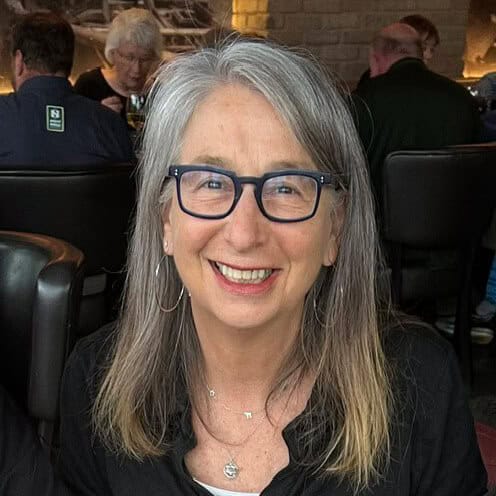
Barbara Fields shares the Holocaust experiences of both of her parents, Fred Fields (Ferdinand Eisfelder) and Yvette Simon Fields, who escaped Nazi persecution through very different journeys. Through their story, students learn about Jewish life in Germany before the Holocaust, Kristallnacht and the rise of antisemitism, Jewish refugees in Shanghai, escape through France and North Africa, the experiences of refugees rebuilding their lives after the war, and the devastating loss of extended families during the Holocaust. Barbara also encourages students to consider the lasting impact of displacement, resilience, and the responsibility to confront antisemitism, prejudice, and hatred in their own communities.
About Barbara
Barbara Fields is a second-generation Holocaust educator who shares her family’s story through the Sandra Bornstein Holocaust Education Center Speakers’ Bureau. She grew up in the suburbs of New York City, moved to New England for college, and has lived in Rhode Island for more than 30 years. She lives in Providence, where she raised her two children.
Professionally, Barbara spent four decades as a leader in affordable housing and community development at the local, state, and national levels. Through her presentations, she helps students understand the experiences of Jewish refugees, the devastating impact of the Holocaust on Jews and other targeted groups, and the importance of standing up to antisemitism, prejudice, and hatred.
Parents: Fred Fields (Ferdinand Eisfelder) and Yvette Simon Fields
Before the War
Barbara’s parents grew up in Germany. Her father, Fred Fields, was born in Berlin in 1919. As a Jewish teenager, he witnessed the rapid rise of antisemitism under Nazi rule.
Their Holocaust Story
Fred was an excellent student and a passionate soccer player. After Jewish athletes were expelled from German sports leagues, he continued playing on teams organized by the Jewish community. As conditions for Jews worsened, Fred’s mother helped him escape Germany. Traveling alone, he fled in December 1938 at the age of 19 and found refuge in Shanghai, China, one of the few places in the world that accepted Jewish refugees without requiring visas or passports. There, he rebuilt his life while working for two German-language Jewish newspapers, the Gelbe Post and the Shanghai Jewish Chronicle.
Barbara’s mother, Yvette, and her family initially escaped Germany by fleeing to Paris, France. After the Nazis invaded France, they were forced to flee once again. Following an arduous journey that took them through southern France, Algeria, and Morocco, they arrived safely in the United States in 1942.
More than three dozen members of Barbara’s extended family, including her paternal grandparents, were murdered in the Holocaust.
After the War
After World War II, Fred remained in China, where he worked for the United States Army before a U.S. soldier and his mother helped him immigrate to the United States. In 1948, in New York City, he met Yvette on a blind date. They married soon after and built a new life together. Like so many Jewish refugees, their experiences of displacement, resilience, and rebuilding shaped the values they passed on to future generations.